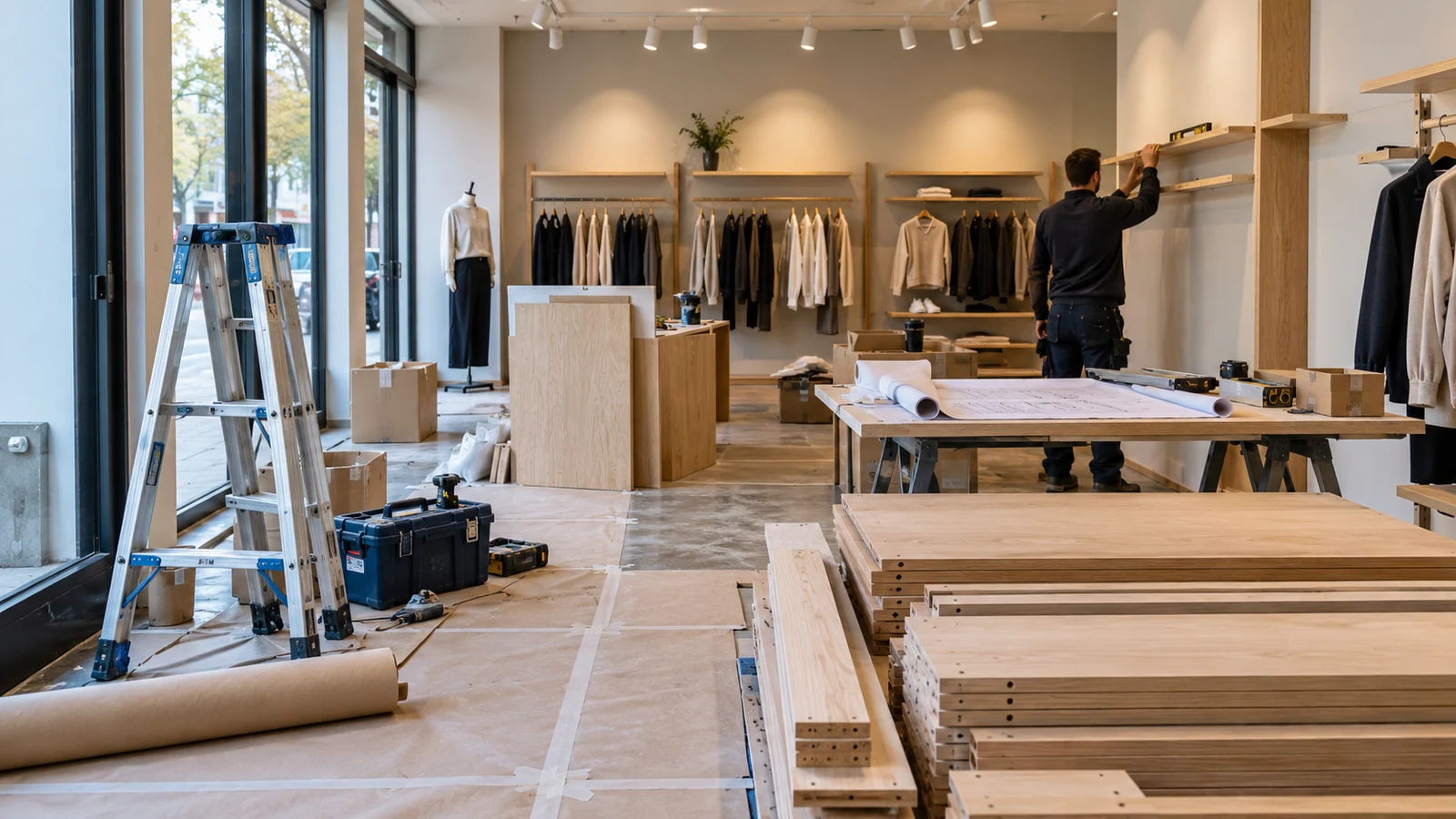

The fit-out is one course and the opening is the meal. We break a restaurant build into eight workstreams, show where the time goes across design, plan review and construction, and cover sequencing, multi-location programs, handover gates, remodels and weekly tracking.
In the openings we see, the date rarely slips on the job site. It slips around it. Plan review comes back with comments. The hood can’t ship until the drawings lock. Nobody booked the health inspector. The crew hired for opening week starts on a Monday that has already moved. The GC hits every milestone and the doors still stay shut.
The fit-out is one course. The opening is the meal. Restaurant project management has to carry the whole thing: lease, design, permits, equipment, hiring, inspections and handover, each with a named owner and a date, and run the same way on site ten as on site one. That is mise en place for a build.
Here is how we run it, section by section: where the time goes, the sequence, the outside parties, the multi-site view, the handover and the four numbers we review every week.
What does restaurant project management cover beyond the fit-out?
Construction is the loudest workstream, so it gets the project manager. The openings that run late slip somewhere quieter, in a permit queue or an equipment order nobody placed. We split a restaurant opening into eight workstreams. The commercial fit-out is one of them, and most of the other seven depend on someone outside your company.
| Workstream | Internal owner | Outside parties | What stops the opening |
|---|---|---|---|
| Lease and possession | Real estate | Landlord, landlord’s counsel | A possession date in writing |
| Design and permits | Store development | Architect, MEP engineer, city, health department | Plan approval |
| Construction and fit-out | Construction lead | GC, subcontractors | Hood, rough-in, inspections |
| Equipment | Procurement | Equipment dealer, installers | Delivery against site readiness |
| Hiring and training | Operations | Staffing agency, if used | A trained crew on the date |
| Inspections and licenses | Compliance | Fire, building and health inspectors | Certificate of occupancy, health permit |
| Handover | Head of operations | GC, equipment installers | Punch list closed |
| Launch | Operations and marketing | Agencies, delivery platforms | Menu live on POS and platforms |
Here, restaurant project management means the one-off work of building, fitting out, remodeling and opening a site. It does not mean the daily routine of running one. That routine belongs to your POS, scheduling and inventory tools, and it starts the day the project ends. The project side is new store opening project management with a commercial kitchen, a hood and a health inspector added to the plan.
Where does the time go in a restaurant fit-out?
One Dallas permit expediter’s timeline for a restaurant renovation with no zoning change allows six weeks for design, six for plan review, eight for construction and one for final inspection. That is 21 weeks, and construction is eight of them: about 38 percent. The other 13 weeks belong to architects, reviewers and inspectors, and each of those has an owner on your side who has to chase them.
That split changes how you plan. A project manager who watches only the GC is watching 38 percent of the schedule. We watch the other 62 percent first, because it sets the date the GC is allowed to start.
Count the opening date back through construction, plan review and design. That is the date design had to finish, and the team needs to see it on day one.
How do you sequence a restaurant construction project?
This is the spine of the restaurant project management plan we use on a build. The order holds on every site. The durations change with the jurisdiction and the GC.
| # | Step | Gate that closes it | Owner | Outside party |
|---|---|---|---|---|
| 1 | Lease and possession | Possession date confirmed in writing | Real estate | Landlord |
| 2 | Design freeze | Hood, suppression, electrical load and plumbing locked | Store development | Architect, MEP engineer |
| 3 | Plan review | Building and health approvals in hand | Compliance | City, health department |
| 4 | Equipment order | Long-lead items released against the frozen design | Procurement | Equipment dealer |
| 5 | Rough-in | Mechanical, electrical and plumbing passed | Construction lead | GC, subcontractors |
| 6 | Finish and install | Equipment set and commissioned | Construction lead | GC, installers |
| 7 | Pre-opening inspections | Fire, building and health sign-off | Compliance | Inspectors |
| 8 | Punch list and handover | Open items closed, files and keys to operations | Head of operations | GC |
| 9 | Trial service and launch | Crew trained, POS and menu live | Operations | None |
Two rules carry most of the weight. First, release long-lead equipment orders at design freeze, not at permit approval. The hood and suppression system sits in the permit set, so it locks first, and everything that depends on its dimensions locks behind it. Second, book every inspection as a dated task with an owner. An inspector’s slot is a dependency like any other, and the one nobody books is the one that holds the opening.
Sequence matters to the regulator as well. Jurisdictions that adopt the FDA Food Code require plans for a new food establishment, and for remodels the regulator flags, to be reviewed and approved before construction starts. Washington’s version is a clean example. Work that starts ahead of approval gets redone after it.
How do you coordinate the GC, the landlord and the equipment dealer?
Four outside parties hold most of a restaurant schedule: the GC, the landlord, the equipment dealer and the inspectors. Each one answers on a different channel and each one blocks a different gate.
| Party | What they owe the plan | Gate they hold | Where they answer |
|---|---|---|---|
| GC | Progress updates, answered RFIs, punch list items closed | Rough-in, install, handover | Email, site calls, their own construction platform |
| Landlord | Possession, landlord works, utility and signage approvals | Lease and possession | Email, through a property manager |
| Equipment dealer | Order confirmation, delivery date, installer slot | Equipment order, install | Email and phone |
| Inspectors | An inspection date and a written result | Pre-opening inspections | Their own scheduling channel |
Give each party one task at a time, with a date and a named owner on your side. A single task is easy to answer and easy to chase. A forty-line email thread is neither.
Scope what they can see. A dealer needs the delivery window and the site contact. The dealer does not need the budget or the lease. That is why we scope outside access to the task: each party sees what they owe and nothing else.
Chase on a schedule you set once, so a pending or overdue task gets a follow-up without anyone remembering to send it. The people who run your openings are already running sites. Reminders should not depend on their memory.
How do you run restaurant fit-outs across multiple locations?
A program of ten sites is one workflow run ten times with ten sets of local variables. The job is deciding which parts repeat and which belong to the city or the landlord. That is the same discipline behind any multi-store rollout.
| Set once for the program | Set per site |
|---|---|
| Layout and equipment package | Permit path and review contacts |
| Workstream sequence and gate definitions | GC and subcontractor pool |
| Approval routes and named owners | Landlord work letter and possession terms |
| Reporting format | Schedule buffer for the jurisdiction |
Buffers belong to the site. Site civil work is where that shows up: consultants who plan retail and restaurant programs report that permitting, utility coordination, stormwater approvals and unforeseen site conditions are the usual cause of slippage, and that a single site issue can push a timeline back by months. Those delays attach to a specific landlord and a specific parcel, so the buffer attaches to the site, not the program.
Handoffs, not sites, set the size of a multi-site program. Our illustration: twelve sites with fifteen handoffs each, across design, procurement, the GC, compliance and operations, is 180 handoffs open at once. If one in ten is waiting on a reply, that is 18 loops to chase every week, on top of running the openings. Count your own. The total tells you how much coordination the program needs.
The same logic holds for restaurant and QSR teams opening their first ten sites in a new market. The workflow you build for site one is the asset. Site two should cost an edit, not a rebuild.
What does a clean restaurant handover look like?
In a kitchen, nothing leaves the pass until someone checks the plate. A build needs the same checkpoint between the GC and the operator, whether the site is a restaurant or a hotel pre-opening. Handover is the pass.
Operations accepts the keys when all seven gates are closed:
- Certificate of occupancy issued.
- Equipment commissioned and tested.
- Fire suppression inspected and tagged.
- Health department pre-opening inspection passed.
- Punch list closed, or every open item carries an owner and a date.
- Warranties, manuals and as-built drawings filed with operations.
- Trial service run with the trained crew.
The health permit has its own clock. Washington’s rule, which follows the Food Code, asks for the permit application at least 30 calendar days before opening. That makes the application date a fixed point on the plan, set by the opening date and not by when construction finishes.
Trial service is the gate teams skip, because it needs the crew trained and the POS live. That puts hiring and launch on the critical path of the handover, which is why we keep all eight workstreams in one plan.
How do you manage a restaurant remodel project?
A remodel is a build with a trading restaurant attached. The first decision is whether you close, the same call that shapes any retail store renovation.
Phase the work if the line keeps trading through it. Close the restaurant when scope touches the hood, the grease trap or the main electrical, because those take the kitchen offline for days that no amount of phasing recovers. Everything else is a scheduling problem.
A remodel adds three workstreams a new build does not have: a temporary operations plan for prep, storage and signage; staffing cover for the weeks the line runs short; and a reopening gate that repeats the handover above on a smaller scale. Run them in the same workflow as the construction tasks — our restaurant refurbishment template starts there — with the same owners and the same dates.
Which restaurant project management software fits a build?
Most teams run a build on four things at once: a spreadsheet for the tracker, the GC’s construction platform for drawings and RFIs, email for approvals, and a WhatsApp or text thread for anything that needs an answer today. Each does its job. None of them carries the owner’s opening plan, which crosses all four.
A build adds outside parties and hard dependencies, which is where a workflow with approvals earns its place. Whatever you pick, test it against six requirements.
| Requirement | Why it matters on a build |
|---|---|
| A named owner on every task | A team name on a task leaves nobody accountable for the date. |
| Dependencies that hand work on | When design freezes, the equipment order lands with procurement without anyone forwarding an email. |
| Outside parties act without a login | A GC or a landlord will not learn a new tool for one site, so the tool has to meet them in email or WhatsApp. |
| Approvals inside the plan | Design sign-off, CapEx and permit submission sit on the critical path. They belong in the plan, not in a side conversation. |
| One view across every site | The program lead needs overdue and stuck work in one place, not twelve trackers. |
| A reusable template | Site two starts from site one’s workflow. |
If the plan has to live beside the tools your team already uses, check how it connects to them before you move anything into it.
How do you track a restaurant build while it is running?
Four measures tell you where the program stands. Each one points at an owner who can act on it.
| Measure | What it answers | Who acts |
|---|---|---|
| Planned versus current timing, per site | Which openings have moved and by how many days | Program lead |
| Overdue tasks and average overdue duration | Whether delay is a spike or a drift | Program lead, task owners |
| Tasks needing attention | What needs a decision today | Task owners |
| Where work is stuck | Whether one workstream, such as permits or equipment, is holding several sites | Head of projects |
Run the weekly review from the project progress report for each site, not from a status call. The conversation moves to decisions because the owners and dates are already on the page.
Why we built Nodomo for restaurant openings
Restaurant builds slip on handoffs. The architect is waiting on the hood spec, the dealer is waiting on a purchase order, and nobody booked the inspector. Each of those waits sits in one person’s inbox.
We built Nodomo so each wait becomes a task with one named owner, a deadline and a dependency. When a step completes, the workflow moves to the next person. GCs, landlords and equipment dealers complete their tasks through email or WhatsApp with no Nodomo account, and what they can open is scoped to their task, not your project. Pending and overdue tasks get follow-ups automatically, and the portfolio dashboard shows every site in flight: what is overdue, what needs attention and where work is stuck.
Build the workflow once, starting from our restaurant opening template, and run it for each site. The AI workflow builder drafts a workflow from a written process, a spreadsheet or a file, and you review and edit it before anything runs. A simple workflow can go live in the first session. A complex one, we convert with you. Chaayos mapped their opening process this way, with named owners, connected dependencies, approvals, and external stakeholders acting by email.
Nodomo does not make a city review faster or a landlord quicker. It removes the days lost between the people waiting on each other. We sell it, so test it on a real site.